Prompt
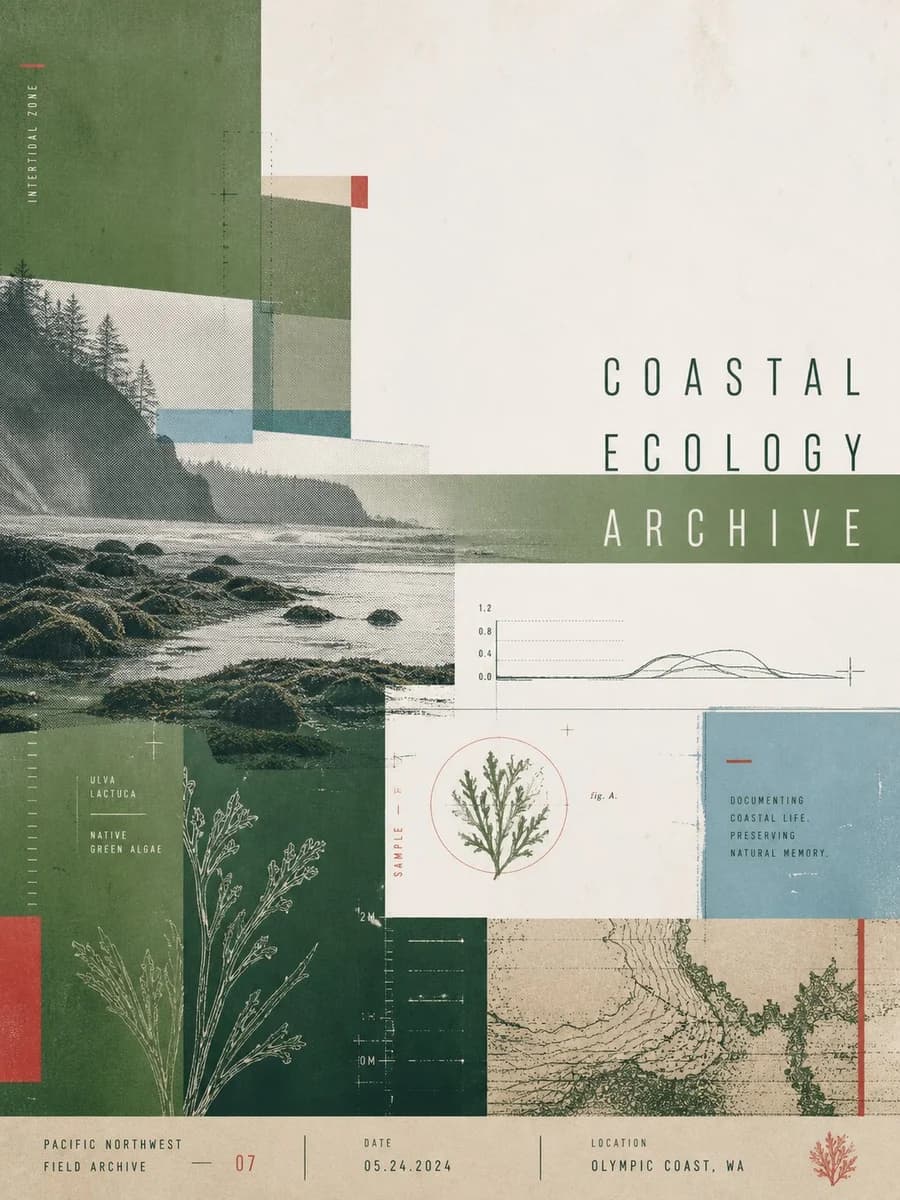
562 wordsGoal: Create a calm, information-dense exhibition poster for a coastal natural-history archive, combining geometric slicing, archival field-notes aesthetics, and muted Pacific Northwest ecology imagery.
Canvas: Vertical 3:4 poster, off-white aged paper background with subtle stains, dust, print grain, and screen-printed halftone texture. Overall mood is quiet, restrained, scientific, and museum-like.
Layout: Use an asymmetrical collage grid with overlapping translucent rectangular slices. The left half is dominated by a large monochrome coastal landscape photo showing a rocky ocean shore, low surf, misty cliffs, and dark evergreen trees. The right half contains open negative space and the main title. Add a horizontal translucent sage-green band crossing the title area. Use thin technical registration marks, dotted measurement lines, small crosses, and faint grid ticks throughout.
Main title text: Set the large headline in tall, narrow, widely spaced uppercase sans-serif letters on the right side in dark desaturated green: {argument name="headline text" default="COASTAL ECOLOGY ARCHIVE"}. Stack it as three lines, aligned slightly right of center, with the third line crossing the green band in pale off-white.
Visible text elements: Include exactly 10 distinct text groups: 1) vertical left label “INTERTIDAL ZONE”; 2) main title “COASTAL ECOLOGY ARCHIVE”; 3) algae label “ULVA LACTUCA / NATIVE / GREEN ALGAE”; 4) small vertical red label “SAMPLE F”; 5) tiny caption “fig. A.” near the algae specimen circle; 6) blue card text “DOCUMENTING / COASTAL LIFE, / PRESERVING / NATURAL MEMORY.”; 7) bottom-left footer “PACIFIC NORTHWEST / FIELD ARCHIVE”; 8) bottom center index “07”; 9) bottom metadata “DATE / 05.24.2024”; 10) bottom-right metadata “LOCATION / OLYMPIC COAST, WA”.
Image and diagram elements: Include exactly 7 main visual elements: 1) the large coastal shoreline photo on the left; 2) a white botanical line drawing of branching algae in the lower-left green block; 3) a small circular botanical specimen illustration in the lower middle, enclosed by a thin red circle; 4) a simple scientific line graph with dotted horizontal gridlines above the specimen; 5) a pale blue rectangular note card on the right; 6) a beige-green contour-map texture panel along the lower right with a single vertical red stripe near its right edge; 7) a small red coral or seaweed icon in the bottom-right footer.
Geometric composition: Include exactly 9 prominent color blocks: 1) large vertical forest-green block at upper left; 2) translucent pale cream rectangle over the photo near upper left; 3) muted green rectangle near upper center; 4) narrow red accent rectangle near upper center-right; 5) wide translucent sage-green horizontal band through the title; 6) deep green lower-left specimen block; 7) narrow red vertical accent at the far lower-left edge; 8) pale blue note-card rectangle on the right; 9) beige map panel at lower right.
Color palette: Desaturated forest green, sage green, seafoam blue, faded teal, warm ivory, charcoal ink, muted brick red accents, and aged beige. Keep contrast soft and avoid bright saturated colors.
Typography and style: Use condensed uppercase technical typography with generous letter spacing, small archival labels, thin rules, and minimal scientific annotations. The poster should feel like a contemporary gallery exhibition print, a field archive page, and a coastal ecology research document at once.
Constraints: Preserve the exact count of 10 text groups, 7 main visual elements, and 9 prominent color blocks. Do not add people, animals, logos, QR codes, or extra large text. Keep the composition flat, editorial, geometric, grainy, and print-based rather than photorealistic.About this prompt
Coastal Ecology Archive Poster is a ready-to-use infographic prompt for GPT Image 2 on Image 2. Copy the 562 words below, paste them into the Create form, and you will get a result close to the preview above. Tweak the Infographic, Product, Travel tag if you want to push it somewhere new.
Use it as a starting point, then adjust the subject, lighting, or composition to suit your idea. The credit cost stays the same whether you use it as written or customize it.
Use case
A strong starting point for Infographic
Start here when you want a infographic image inspired by Coastal Ecology Archive Poster. The prompt already sets the look and composition; replace the subject, product, colors, or scene details to match your project.
Easy places to tweak
- Subject Swap in your person, product, place, or object without changing the overall composition.
- Look and mood Tune the lighting, palette, camera angle, or materials so the image fits your brand.
- Final format Set the aspect ratio, background, text, or layout notes before you generate.
More prompt paths to explore
Find more GPT Image 2 prompts with a similar style, use case, or subject.
How to use it
- Step 1
Copy the prompt
Hit the Copy button above to grab the full text.
- Step 2
Open Image 2 Create
Head to the Create form and paste it in.
- Step 3
Generate
Hit Generate. Your version lands in seconds.
Make it yours
Load the prompt into the Create form with one click, then start tweaking.